Our research in the media: reflections on baboons, coexistence, and complexity
Unruly Natures research has recently been catching the attention of media outlets. This gives us the opportunity to communicate our findings more broadly and keep raising awareness, not only about human-baboon interactions in Cape Town, but also about the wider question of how we live with wildlife in a complex, dynamically changing world.
World Wildlife Day 2026: an op-ed and a radio interview
To mark World Wildlife Day (3 March), Kinga was invited to write an opinion piece for the Cape Argus, drawing on her research to reflect on how we might better navigate human-wildlife relationships. She was also invited to join HelderbergFM’s morning show Wild Wednesday for a radio interview.
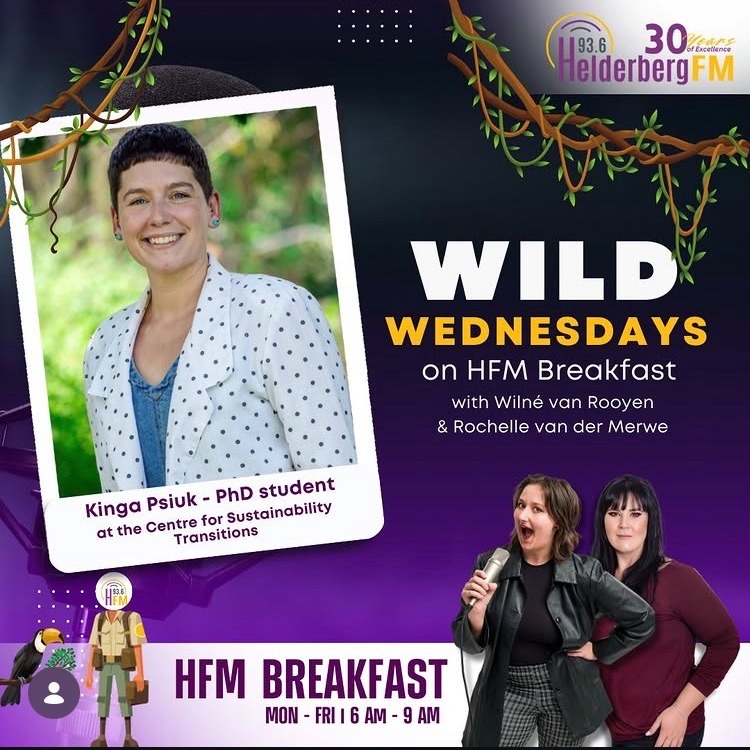
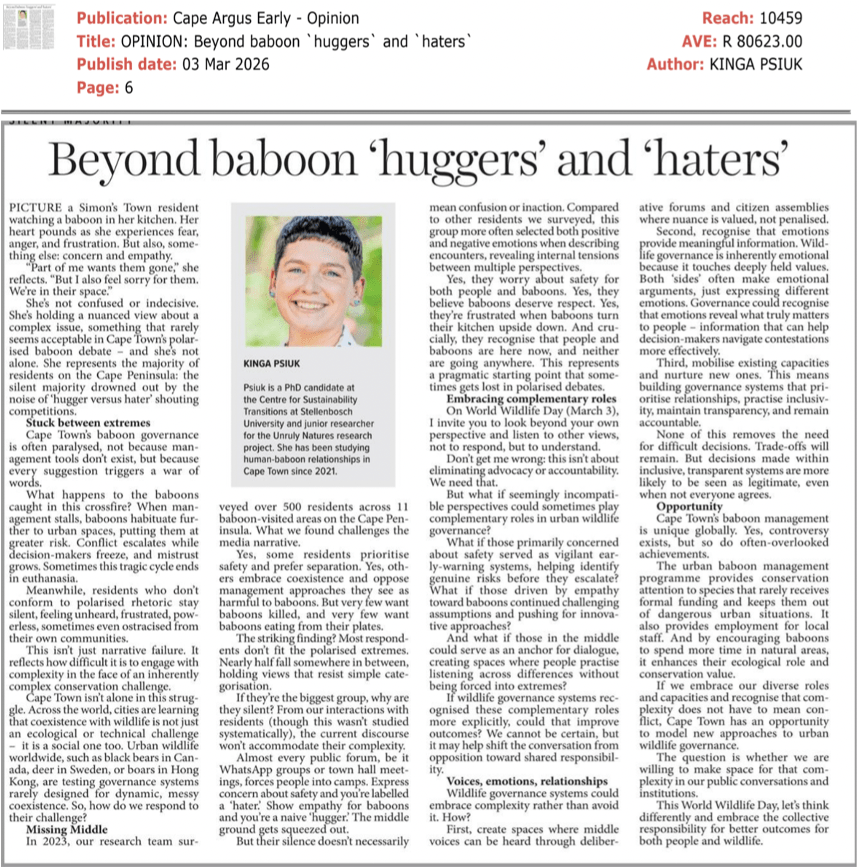
Together, these two contributions invite us to recognise the diversity of opinions and experiences that exist in the baboon context and to think about how we can engage with that diversity and complexity more constructively: at the individual level and in our governance spaces.
A key point made in both op-ed and interview is that many residents are already navigating coexistence pragmatically, but quietly, away from the noise of heated debates. Current public forums, whether social media or town hall meetings, tend to fuel polarisation and squeeze these ‘middle’ voices out of public deliberation. With these voices underrepresented in the public conversation, even though they are the largest group, it is easy to let the nuances fall through the cracks, perpetuating existing polarisation.
Kinga also encourages a shift in how we frame the challenge: moving away from the idea of solving conflict, toward the idea of navigating it. That shift opens up different questions and opportunities, including what capacities we need, individually and collectively, to meet conservation challenges like the human-baboon situation in Cape Town. Conservation and coexistence are not fixed models, but rather ongoing practices of navigating trade-offs and tensions, and they require collective responsibility. This is exactly the kind of complexity our research aims to sit with.
Read the Cape Argus op-ed here
Listen to the radio interview (13 min) here
International visit: What does urban wildlife teach us about life in the Anthropocene?
Johan is currently on a trip to Europe, spending March at Stockholm Resilience Centre Unruly Nature’s academic home in Sweden. But on the way there he was also invited to York University’s Leverhulme Centre for Anthropocene Biodiversity, to host another Unruly screening and join Christopher Lyon, Hanna Pettersson and Felicia Liu on a panel to discuss how the Unruly Natures project connects to LCAB’s work on wildlife conservation, human-nature relationships, arts and activism. It was an intimate mid-morning screening with 15-20 academics followed by a lively panel discussion that continued over lunch. It was unfortunately not recorded, but do feel free to check out Dr. Lyon and Dr. Pettersson’s recent paper “New Life on Earth: biodiversity change and humanity in a novel future“, Dr. Liu’s work on art and activism and Dr. Pettersson’s publication about the conundrum of human-wolf relationships in Europe.
Lastly, on our website you’ll find a recent blog post that was not sent out as an email. It was to acknowledge a student-led project that was rolled out primarily online, comparing human-wildlife relations in Cape Town and Hong Kong. We wanted to limit the number of emails we send to subscribers, but more information about the study and findings will be shared in a future post by the student, Betty Sing Yi Woo.
 Unruly Natures Project