Dear subscribers, it’s been a while since our last post, but we are finally ready to share several new and exciting developments.
Project updates
After a long and competitive application process, Johan and a team of researchers in four countries have secured funding for a new project called “BiodiverCities: A Roadmap for Fostering Human-Wildlife Coexistence in Greening Cities.” This is very exciting, and will allow us to continue and expand our research in Cape Town – and also to bring our findings and insights here into conversation with research in cities elsewhere, that face similar challenges related to living alongside urban wildlife. The project’s goal is to develop an interspecies etiquette: a set of principles and practices that can act as a code of conduct for cities that humans share with other species.
BiodiverCities will run for three years, and consists of an interdisciplinary team of researchers that in addition to Cape Town bring together case studies from Stockholm (Sweden), Freiburg (Germany), and Genk (Belgium.) The team is led by Dr. Erica von Essen at Stockholm University, with Dr. Johan Enqvist helping to coordinate the overall project as well as leading the research in Cape Town. For this he will be based part-time at Stellenbosch University, and also work closely with Dr. Patrick O’Farrell and MSc student Tamara Munesamy at the University of the Western Cape. The Cape Town research for BiodiverCities is funded by the South African National Research Foundation (NRF), while the rest of the BiodiverCities team is supported by funders in the three other countries through the European Biodiversa+ initiative.
What does this mean for Unruly Natures?
The original funding for our work in Unruly Natures is coming to an end this year, however with Johan’s new project and Kinga’s ongoing PhD work we will keep this website active until at least 2029. It will serve two purposes: first, we will continue to use it to announce updates about Unruly Natures as publications come out and whenever we present any of our work to the public. Second, the website will also serve as the home for the Cape Town component of BiodiverCities, since this work will continue in a similar direction to understand and improve human-wildlife relations in Cape Town. In the coming months you may see some updates in the contents of the website as a whole, to better reflect this. For now, feel free to also read more on the BiodiverCities website.
As mentioned earlier, we are preparing to make the filmed version of the Unruly play publicly available together with a resource pack that is almost finished. The timeline for this release is September/October. The publication dates for our upcoming journal articles on the Unruly Natures research are harder to predict since this process is partly in the hands of expert reviewers, but all publications will be announced here.
On that note, we are very proud to announce that MSc student Sing Yi Betty Woo successfully defended her thesis in June, with the title “Eliciting empathy through comics: Narrative communication of divergent perspectives on urban wildlife in Hong Kong and Cape Town.” Her thesis, which we mentioned in a previous post, studies how narrative visual stories can be used to foster empathy for different viewpoints around baboons and wild boars in cities. It is a really unique and ground-breaking study that shows both potential strengths and weaknesses with visual communication, revealing that it is easier to stimulate empathy for less favoured perspectives than more commonly held ones. Both the thesis and the comic can be found on our Outputs page.
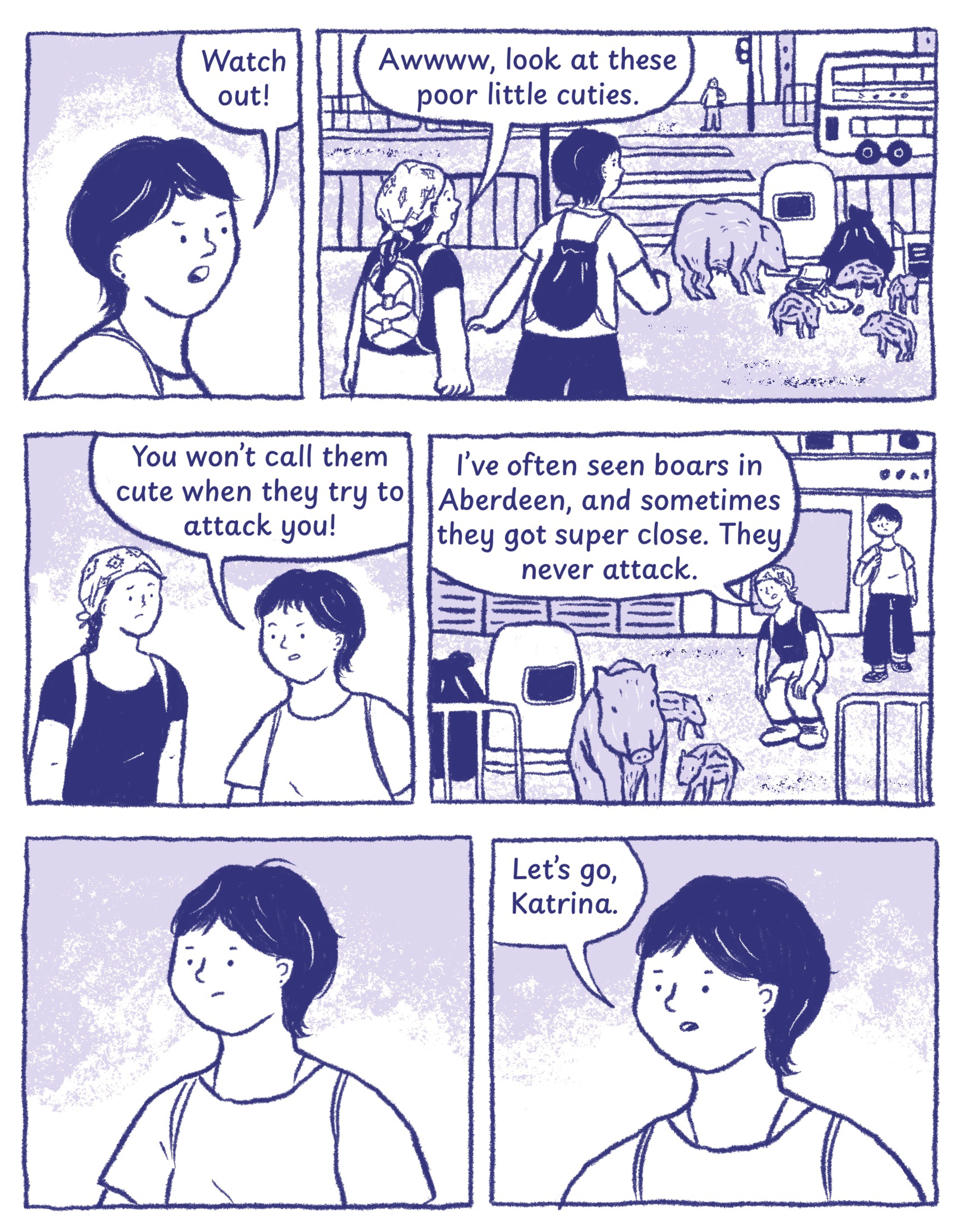

Excerpt from the comic used in Betty’s thesis, for Hong Kong and Cape Town.
Johan has also co-authored an article that draws partially on Unruly Natures work, published under open access in the journal Current Opinion on Environmental Sustainability, titled “Transforming the nature of cities — stewardship and more-than-human agency.” It reviews recent scholarship about urban nature and argues that environmental stewardship needs better ways of managing tensions between humans and non-human city dwellers. The article is also available under our Outputs tab.

